Water entering Winter Garden homes follows gravity toward slab edges, pooling in low spots and spreading under cabinets before homeowners see it. IICRC crews map every path and dry continuously to stop mold.

Crews identify where water entered, whether through the roof, foundation crack, window, or yard drainage failure. Winter Garden's mixed housing ages require careful investigation to find the true entry point.
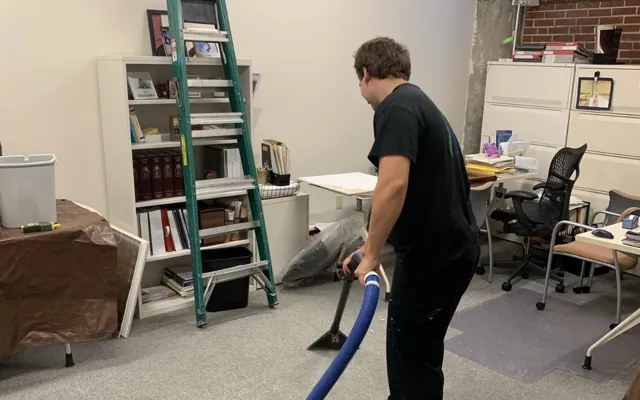
Extraction equipment pumps from all floored areas and subfloor spaces. Winter Garden homes often have water trapped under cabinets or in closets that needs positive extraction rather than passive drying.
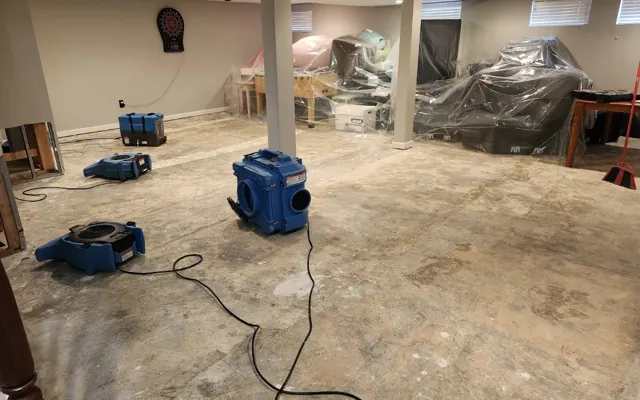
Drying equipment runs continuously, repositioned based on daily moisture readings. Crews stay involved until Winter Garden home reaches trained-dry status and mold risk has passed.

Water extraction alone in Winter Garden typically runs $300 to $1,500 for a single affected room, scaling up to $3,000 to $10,000 or more for multi-room or whole-home events after major storms. The exact cost depends on water volume, how long it sat, and how much structural drying is needed on top of extraction. Crews document the cause and scope clearly since that affects which insurance coverage applies.
Winter Garden's blend of century-old downtown buildings and sprawling newer suburbs all face flat, high water table terrain where water has nowhere to go but into slab foundations. Newer homes still settle into sandy soil, creating gaps where storm runoff seeps inside. Older structures leak through aging roofs and foundation cracks. Winter Garden's historic core and new neighborhoods both sit on Central Florida's flat, low-lying terrain with a high water table. Storm runoff overwhelms yard drainage, and slab construction means water spreads laterally under flooring. Older roofs and newer construction settling both create water entry points. From Winter Garden, crews also cover nearby Hunters Creek, Oviedo, Apopka, Winter Springs, Lake Nona, Wekiwa Springs. See every neighborhood and town on the full service area page.
See all areas servedEvery loss is photographed, measured, and logged from the first visit, so the paperwork holds up with your insurance carrier.
Technicians follow recognized IICRC drying standards and prove the work with daily moisture readings, not guesswork.
Emergency dispatch any hour of the day or night, with a real crew on the way, not a callback in the morning.
A real crew dispatched any hour, not a callback in the morning.
Trained technicians following recognized IICRC drying standards.
Truck-mounted, portable, and submersible for any size loss.
The loss is documented and billed to the carrier directly.
Crews use a combination of industrial air movers, dehumidifiers, and sometimes moisture barriers to dry subfloor spaces in Winter Garden homes. Daily moisture checks guide equipment repositioning so water is driven out rather than trapped, preventing mold and structural rot.
Yes, slab homes in Winter Garden are especially vulnerable because there is no basement to catch water and no crawl space for air circulation. Water spreads laterally under flooring, so detection and extraction must be fast to prevent hidden mold growth in Winter Garden's humid climate.
Crews are on call 24 hours a day and can be on the way to Winter Garden within the hour.
Call (689) 308-3723