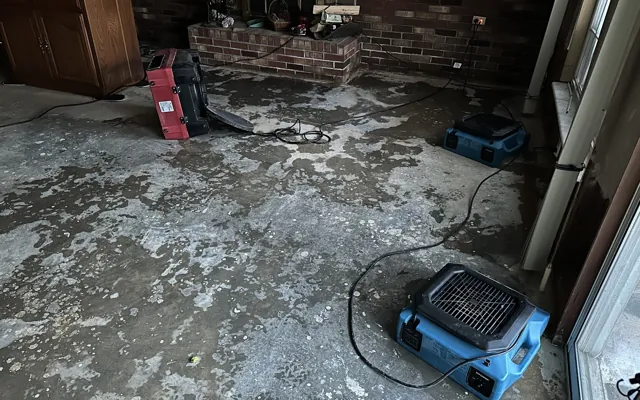
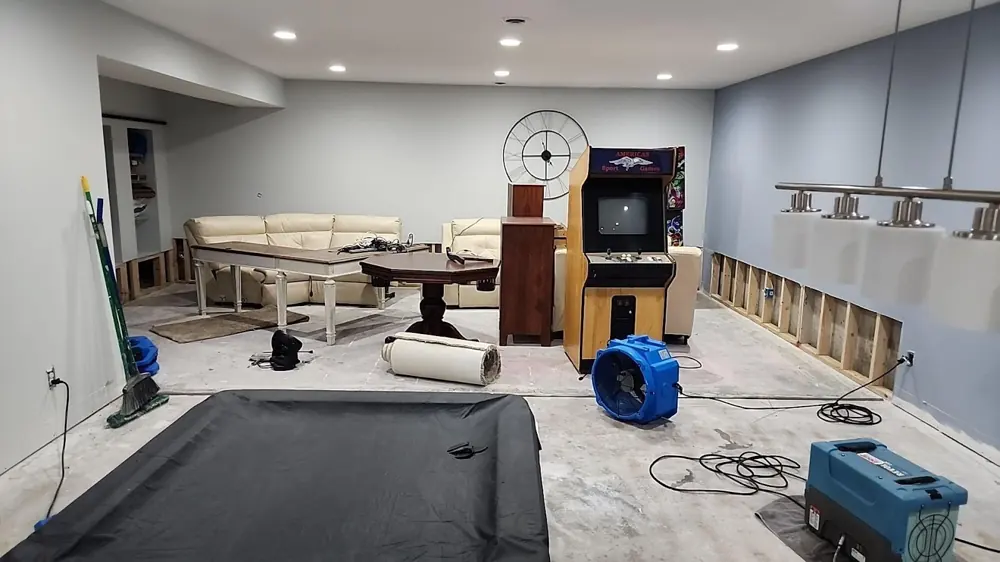
Hurricane season rain can turn a flat Orlando yard into standing water at your door within an hour. Damp Solving Water and Mold responds fast, IICRC-standard and local to Orange County.

Truck-mounted and portable pumps remove standing water from floors, garages, and lanais as fast as possible after the storm passes.
Crews assess whether floodwater carried outside contaminants and treat surfaces accordingly before drying begins.
Industrial air movers and dehumidifiers dry flooring, baseboards, and drywall throughout the affected area.
Damaged flooring, drywall, and baseboards are rebuilt once moisture readings confirm the structure is fully dry.

While help is on the way, these first steps, done only where it is safe, limit the damage and protect the insurance claim.
Shut the supply off at the source, or close the home's main valve if the source is not obvious. Stopping the flow limits the damage more than anything else.
Switch off electricity to the affected area, but only if the breaker can be reached without standing in or touching the water.
Get a crew dispatched right away. The sooner extraction and drying begin, the more flooring, drywall, and belongings can be saved.
Take photos and a short video of the water and the affected rooms before anything is moved, so the insurance claim starts strong.
Storm flood cleanup in Orlando ranges widely with the size of the event, from about $1,500 to $5,000 for a single flooded room to $10,000 or more for whole-home flooding after a major hurricane. Standard homeowners insurance generally does not cover rising floodwater, that requires separate flood insurance, though wind-driven rain intrusion is often treated differently. Crews document the source of water carefully since it directly affects which policy applies.
Crews reach Orlando and Central Florida fast, from Winter Park and College Park to Lake Nona, Dr. Phillips, Conway, and nearby Maitland and Altamonte Springs. See the full list on the areas served across Orlando page.
See all areas servedEvery loss is photographed, measured, and logged from the first visit, so the paperwork holds up with your insurance carrier.
Technicians follow recognized IICRC drying standards and prove the work with daily moisture readings, not guesswork.
Emergency dispatch any hour of the day or night, with a real crew on the way, not a callback in the morning.
A real crew dispatched any hour, not a callback in the morning.
Trained technicians following recognized IICRC drying standards.
Truck-mounted, portable, and submersible for any size loss.
The loss is documented and billed to the carrier directly.
Typically not for rising floodwater from outside the home, that requires a separate flood insurance policy. Wind-driven rain that enters through the roof, windows, or doors is more often covered under a standard homeowners policy. Crews document the water source to help clarify which applies.
As soon as it is safe to do so. Standing water left more than 24 to 48 hours significantly increases the risk of mold, especially in Orlando's humidity, and can cause flooring and drywall damage that was otherwise avoidable.
It can be, depending on what it picked up on the way in, including yard debris, fertilizer runoff, or nearby sewer overflow. Crews assess each situation and treat surfaces appropriately rather than assuming it is clean.
If it is safe, shut off electricity to affected areas, move valuables and furniture to higher ground, and take photos of the flooding for your records. Do not wade through standing water near outlets or electrical panels.
Most single-room events dry in three to five days, while whole-home flooding after a major hurricane can take one to two weeks with industrial equipment running continuously throughout the structure.
Orlando crews are on call 24 hours a day, local and fast, and can be on the way within the hour.
Call (689) 308-3723