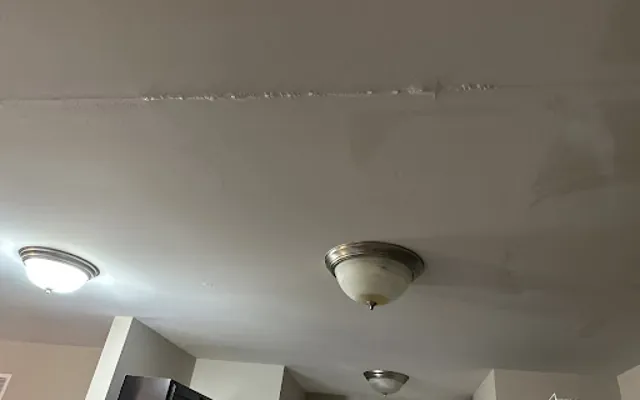
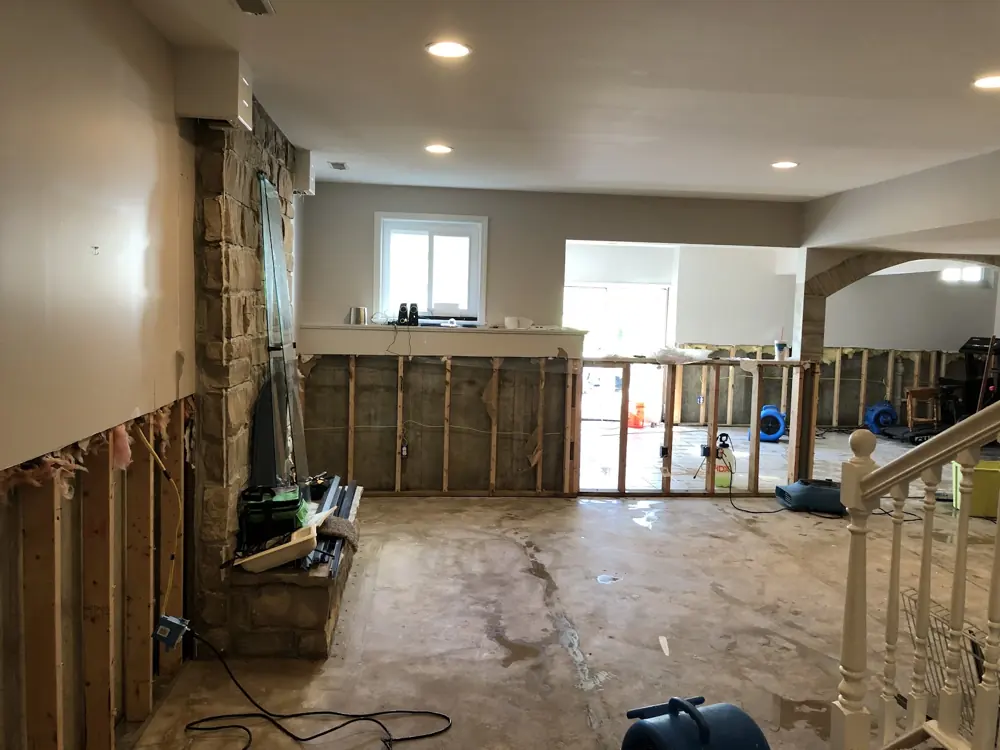
A stained, sagging, or dripping ceiling in Orlando usually means a roof leak, an upstairs plumbing failure, or an AC condensate overflow above. Damp Solving Water & Mold's IICRC-standard crews respond in about an hour.

Crews trace the leak carefully to its true source above the ceiling, whether that is the roof itself, an attic air handler, or an upstairs fixture.
Any pooled water trapped behind the ceiling is released in a controlled, deliberate way and fully extracted to prevent a sudden collapse of the wet drywall.
Air movers and dehumidifiers are set to dry the ceiling cavity and surrounding framing thoroughly and completely, with moisture levels tracked and logged every day.
Damaged drywall sections are cut out and replaced, textured carefully to match the surrounding ceiling, and repainted fully once everything tests completely dry and stable.

While help is on the way, these first steps, done only where it is safe, limit the damage and protect the insurance claim.
Shut the supply off at the source, or close the home's main valve if the source is not obvious. Stopping the flow limits the damage more than anything else.
Switch off electricity to the affected area, but only if the breaker can be reached without standing in or touching the water.
Get a crew dispatched right away. The sooner extraction and drying begin, the more flooring, drywall, and belongings can be saved.
Take photos and a short video of the water and the affected rooms before anything is moved, so the insurance claim starts strong.
Ceiling water damage repair in Orlando typically runs $400 to $3,500, depending on the size of the stained or sagging area, whether insulation above needs replacing, and whether the source requires a roof or plumbing repair too. A small stain from a quick fix costs far less than a collapsed section after days of undetected leaking. Insurance often covers sudden storm or plumbing-related ceiling damage.
Crews reach Orlando and Central Florida fast, from Winter Park and College Park to Lake Nona, Dr. Phillips, Conway, and nearby Maitland and Altamonte Springs. See the full list on the areas served across Orlando page.
See all areas servedEvery loss is photographed, measured, and logged from the first visit, so the paperwork holds up with your insurance carrier.
Technicians follow recognized IICRC drying standards and prove the work with daily moisture readings, not guesswork.
Emergency dispatch any hour of the day or night, with a real crew on the way, not a callback in the morning.
A real crew dispatched any hour, not a callback in the morning.
Trained technicians following recognized IICRC drying standards.
Truck-mounted, portable, and submersible for any size loss.
The loss is documented and billed to the carrier directly.
Not always, but it should never be ignored completely. Even a small stain means water reached the drywall, and behind it there may be soaked insulation or framing that needs drying before mold has a real chance to start growing.
Drywall absorbs water and loses strength quickly, so trapped water above it adds weight the ceiling was never built to hold. A sagging ceiling can collapse without much warning and should be treated carefully rather than pushed on to test it.
Often yes, if crews manage to catch it early enough after the leak starts. Crews use moisture readings throughout to decide how much drywall actually needs to come out versus what can be dried safely in place with targeted air movement.
A common cause in Orlando is an attic air handler with a clogged condensate line, which can drip steadily regardless of the weather outside that day. An upstairs bathroom or laundry leak can also cause a delayed, ongoing stain over time.
Sudden causes like storm damage or a plumbing failure are usually covered under a standard policy. A ceiling leak from years of known, unrepaired roof damage is typically not covered. Crews document the likely cause to help support your claim.
Orlando crews are on call 24 hours a day, local and fast, and can be on the way within the hour.
Call (689) 308-3723