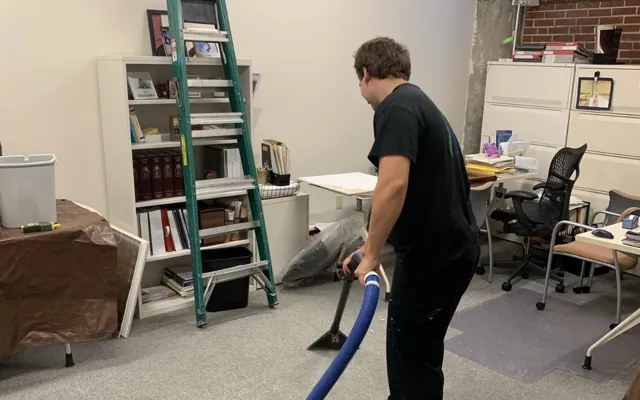
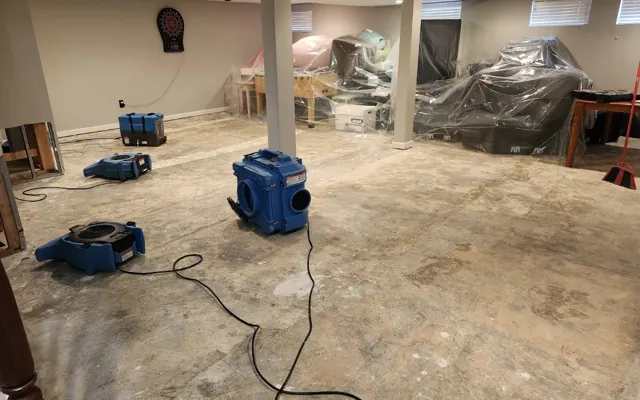
MetroWest's stacked condos and apartments mean water from a failed unit upstairs becomes a ceiling disaster downstairs within hours. Fast extraction and drying prevents neighbor conflicts and mold in this complex community.

Crews shut off the failing water heater or burst line, then extract from all affected units. In MetroWest, identifying which unit(s) the water reached requires checking ceilings, walls, and subfloors across multiple levels.
Moisture meters verify saturation in common areas, attic spaces, or wall cavities shared between units. MetroWest losses often extend to neighbors, so crews document all affected areas for the property manager.
Drying equipment runs in affected units and common areas until readings confirm safety. MetroWest property managers appreciate clear documentation showing when each space reached safe moisture levels.

Water extraction alone in MetroWest typically runs $300 to $1,500 for a single affected room, scaling up to $3,000 to $10,000 or more for multi-room or whole-home events after major storms. The exact cost depends on water volume, how long it sat, and how much structural drying is needed on top of extraction. Crews document the cause and scope clearly since that affects which insurance coverage applies.
MetroWest's 1990s-2000s condos and apartment complexes have shared walls and stacked plumbing, so a failed water heater on the third floor becomes a ceiling leak on the second and a wet subfloor on the first. Property managers in MetroWest call constantly because the moisture spreads fast through shared spaces and mold sets in within a day in Florida's humidity. MetroWest's stacked construction means single water heater failures affect multiple units and create mold risk in shared spaces. Humidity-driven condensation from AC units also pools in common areas. Renters and property managers both depend on fast extraction to limit secondary damage. From MetroWest, crews also cover nearby Conway, Edgewood, Orlovista, Eatonville, Winter Park, Pine Hills. See every neighborhood and town on the full service area page.
See all areas servedEvery loss is photographed, measured, and logged from the first visit, so the paperwork holds up with your insurance carrier.
Technicians follow recognized IICRC drying standards and prove the work with daily moisture readings, not guesswork.
Emergency dispatch any hour of the day or night, with a real crew on the way, not a callback in the morning.
A real crew dispatched any hour, not a callback in the morning.
Trained technicians following recognized IICRC drying standards.
Truck-mounted, portable, and submersible for any size loss.
The loss is documented and billed to the carrier directly.
Call immediately and ask the tenant to contact the unit above to identify the water source. If water is coming from above, crews extract and dry the affected unit(s) while the source unit's tenant coordinates with their water heater or plumbing contractor. Fast response prevents water from spreading to additional units below in the MetroWest building.
Mold colonies can establish themselves within 24 to 48 hours in Florida's humidity, especially in MetroWest's tightly constructed shared spaces. Wet insulation, drywall, and carpet create mold risk quickly. Fast extraction and drying prevent expensive secondary remediation and neighbor complaints in the MetroWest community.
Crews are on call 24 hours a day and can be on the way to MetroWest within the hour.
Call (689) 308-3723